
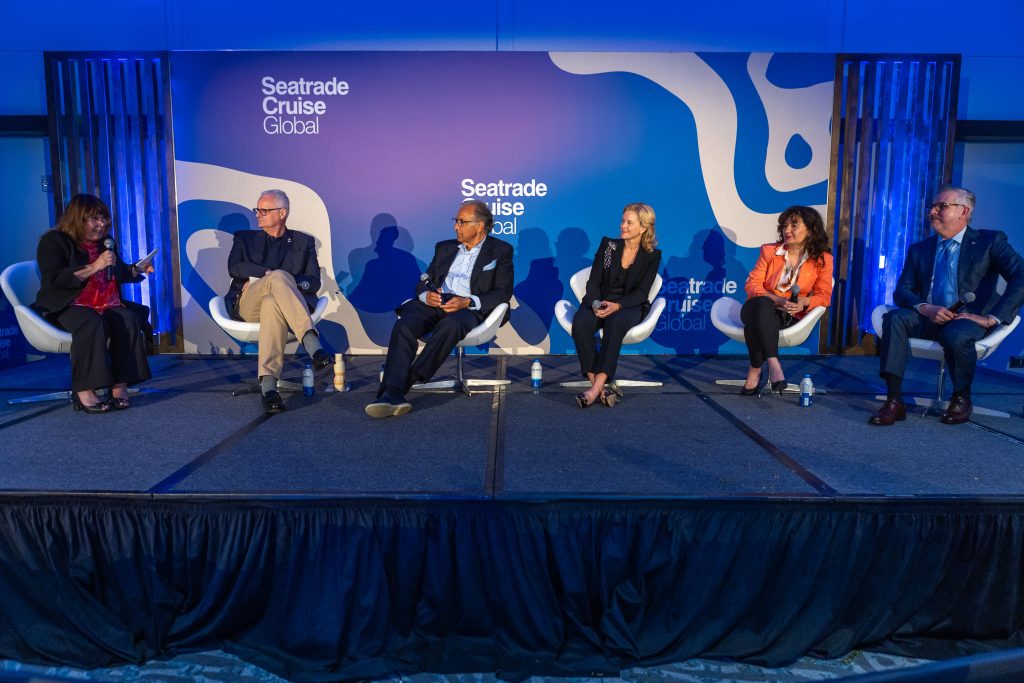
Seatrade Cruise Global 2026 confirmed a shift the industry has been signaling for some time, but had not yet fully confronted. Cruise is still growing, but growth is no longer the competitive advantage it used to be.
Across three days in Miami, the conversation moved beyond ship orders and passenger volumes. What emerged instead was a more demanding reality, where destinations, infrastructure, experience design and reputation are no longer supporting elements, but defining variables of competitiveness.
The implication is structural. The next phase of growth in the cruise industry will not be defined by how much capacity is added, but by how effectively that capacity is deployed and where.
Destinations move to the center of the value equation
The decision to open the week with a full day dedicated to destinations was not incidental. It was revealing.
What was framed as programming reflects a deeper shift. Destinations are no longer being treated as stops within an itinerary, but as active drivers of demand, differentiation and long-term value creation.
Time spent ashore is increasingly tied not only to guest satisfaction, but to economic impact, repeat demand and brand perception. This redefines the role of destinations. They are no longer passive recipients of traffic. They are expected to operate as experience platforms, investment environments and brand assets simultaneously.
As the number of viable destinations expands, the competitive dynamic also changes. Differentiation is no longer defined solely by natural attributes or geography. It is defined by how clearly a destination is positioned, how consistently it delivers its promise, and how effectively it integrates local identity into the visitor experience.
This introduces a new layer of competition: narrative coherence. Destinations that cannot articulate a clear positioning risk becoming interchangeable, regardless of their underlying potential.
Growth continues, but not evenly distributed
The State of the Industry keynote reinforced a familiar message. Demand remains strong, and the sector continues to expand.
But beneath that confidence lies a more complex reality. Growth is no longer frictionless, and it is not evenly distributed.
Infrastructure constraints, regulatory pressure, sustainability requirements and rising operational costs are reshaping how and where that growth can happen. Cruise lines are not just looking for destinations. They are looking for destinations that can absorb scale without eroding experience or efficiency.
This creates a structural divide. Some destinations will capture disproportionate value from the next phase of expansion, while others will struggle to convert inclusion into meaningful economic impact.
In practice, being part of an itinerary is no longer sufficient. The real question is whether that inclusion translates into sustained demand, higher passenger spend and long-term positioning.
At the same time, growth is becoming more nuanced. River cruising, expedition travel and domestic itineraries are gaining relevance, not simply as niche segments, but as strategic levers for diversification, margin optimization and market expansion.
These segments are also shaping expectations across the broader industry. They emphasize experience quality, personalization and lower-density environments, factors that increasingly influence how mainstream cruise products evolve.
From passengers to value: the shift toward experience monetization
Another defining shift is how the industry is redefining value at the passenger level.
The expansion of programming around retail, wellness, entertainment and onboard experience signals a move toward a more sophisticated revenue model.
Cruise is no longer optimizing for volume alone. It is optimizing for value per passenger.
This changes the logic of the business. Experiences are no longer designed solely to satisfy guests, but to increase engagement, spending and long-term loyalty. Retail strategy, immersive entertainment, wellness and technology integration are becoming central to revenue generation.
This shift reflects a broader convergence with hospitality and lifestyle industries, where value is created through ecosystems rather than single products. The ship becomes a platform, not just a vessel.
As this evolution unfolds, positioning becomes increasingly critical. Brands that can clearly define their value proposition, whether through luxury, sustainability, personalization or cultural immersion, are better positioned to capture higher-yield segments.
Reputation as a filter for growth
If infrastructure defines capacity, reputation is increasingly defining access.
Throughout Seatrade 2026, conversations around sustainability, community engagement and experience quality pointed to a deeper shift. Destinations are no longer competing only on what they build, but on how they are perceived.
Reputation is becoming a form of soft infrastructure. It reduces risk, attracts investment and influences deployment decisions.
More importantly, it acts as a filter. Not all destinations will capture the next phase of growth equally, and in many cases, the difference will not be physical capacity, but trust, positioning and perceived readiness.
This has direct economic implications. Destinations perceived as stable, well-managed and aligned with industry expectations are more likely to attract long-term partnerships, premium itineraries and repeat traffic. Those that are not risk being marginalized, even if they remain part of the network.
The competitive gap is therefore widening, not only between regions, but within them.
What this means for Latin America
For Latin America, the signals from Seatrade 2026 are particularly relevant.
The region continues to attract interest from cruise lines due to its geographic diversity, cultural richness and proximity to key source markets. However, interest alone does not guarantee value capture.
The gap between potential and execution remains significant.
In many markets, infrastructure investment has not kept pace with demand, and coordination between public and private stakeholders remains inconsistent. This limits the ability of destinations to scale effectively or to deliver a differentiated experience.
At the same time, positioning challenges persist. While some destinations have made progress in defining their identity and value proposition, others remain fragmented, with unclear narratives and limited alignment between tourism, infrastructure and investment strategies.
This creates a risk scenario. Latin America may continue to receive cruise traffic, but without capturing proportional economic value or strengthening its long-term positioning within the global cruise ecosystem.
The opportunity is therefore conditional. It depends not only on attracting ships, but on building the conditions to convert traffic into sustained growth.
Who captures value and who doesn’t
The emerging pattern is clear. Value in the cruise industry is becoming more selective.
Destinations that combine infrastructure readiness, experience design, stakeholder coordination and strong positioning are more likely to capture higher-value segments, attract investment and secure long-term relevance.
Those that lack one or more of these elements face a different trajectory. They may remain part of itineraries, but with limited economic impact, lower passenger spend and reduced strategic importance.
In this context, inclusion is no longer the objective. Value capture is.
A more connected and more demanding ecosystem
Seatrade 2026 also reflected a broader evolution in how the industry operates.
Ports, destinations, cruise lines, suppliers and investors are no longer acting as separate layers. Growth depends on how effectively these actors align.
The expansion of leadership forums, destination-focused programming and experiential formats is not simply an evolution of the event. It reflects an industry that is becoming more interconnected and, at the same time, more demanding.
Coordination is no longer optional. It is a prerequisite for competitiveness.
The AXON Insights perspective
- Seatrade Cruise Global 2026 marks a clear inflection point.
- The industry is not slowing down, but it is becoming more selective, more complex and more dependent on execution.
- Scale still matters. But scale without coordination, infrastructure without experience, and growth without positioning are no longer sufficient.
- Competitiveness is no longer defined only by physical assets or capacity. It is shaped by how destinations and operators position themselves within the market, how they are perceived, and how consistently they can translate that perception into demand.
- In that sense, reputation is no longer a communications layer. It is a strategic asset that influences investment decisions, deployment strategies and long-term growth.
- For Latin America, the implication is direct. The opportunity is real, but it is not guaranteed.
- The risk is no longer being left out. The risk is being included without capturing real value.
- In this next phase, being part of the cruise map is not the objective.
Capturing value and sustaining relevance within it is.