

The transformation of corporate, institutional, and brand reputation across the region is undeniable. For decades, public relations in Latin America focused on managing visibility and influencing media agendas. Today, that approach is no longer enough.
In 2026, the region enters a new era of PR: one where communicating more does not guarantee authenticity, and where trust — the core reputational asset — has become fragile, volatile, and constantly evaluated by hyperconnected audiences.
Social change, accelerated digitalization, and the expansion of artificial intelligence have reshaped audience behavior. Stakeholders now expect disciplined communication grounded in transparency and evidence. Organizations and brands are no longer competing only for attention, but for credibility, consistency, and cultural relevance.
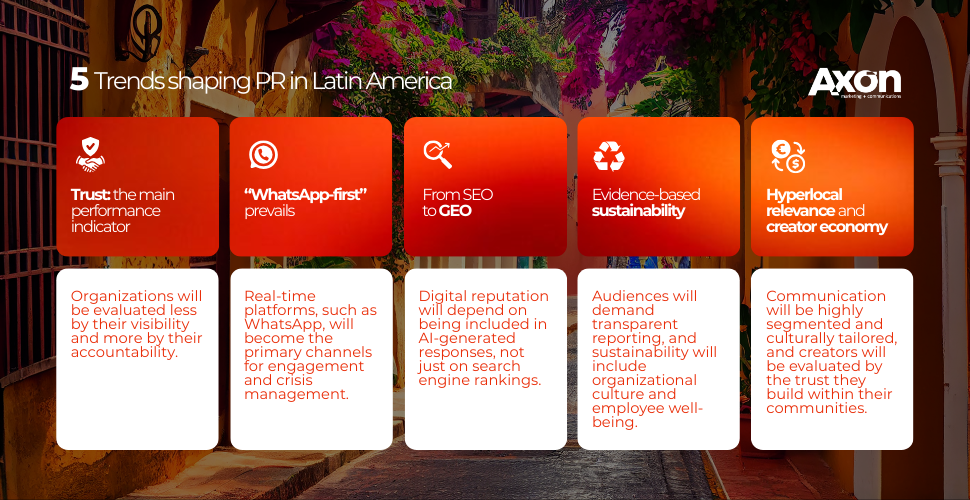
What are the defining PR trends shaping Latin American markets today? Here is what is redefining reputation across the region.
The New Trust Paradigm: From Capturing Attention to Demonstrating Responsibility
For years, communication success was measured by reach and engagement. Today, expectations are far higher.
Latin American audiences now possess digital tools that amplify their capacity for scrutiny: they observe, question, document, and demand constant accountability.
In this environment, organizational messaging carries greater weight. Slogans and announcements are no longer rhetorical devices, they function as public commitments. Delivering on what is promised is no longer optional; it is mandatory.
At the same time, the growing presence of artificial intelligence has made audiences increasingly skeptical of impersonal communication. They want to see the human behind the message.
Empathetic executives, spokespersons, and representatives who communicate clearly under pressure have become critical reputational assets. Leadership humanization is no longer a stylistic trend, it is a credibility requirement.
“WhatsApp-First” PR and the Era of Communication Fragmentation
In Latin America, the channel is not just a medium, it is part of the message. Platform choice shapes tone, proximity, and perceived legitimacy.
Within this landscape, WhatsApp has become one of the most influential spaces in the regional communication ecosystem. Once a private messaging tool, it now functions as a customer service channel, relationship-building platform, and real-time crisis management hub.
Its relevance reflects deeply regional characteristics: a preference for direct communication, a strong value placed on immediacy, and the importance of interpersonal closeness with organizations.
Yet this rise occurs alongside increasing fragmentation of attention. Content consumption is distributed across multiple social networks, video platforms, and closed digital communities, making communication dynamics more ephemeral than ever.
As a result, homogeneous communication strategies are increasingly ineffective. Each country operates within distinct cultural dynamics, and each audience segment displays unique consumption patterns.
PR in Latin America is becoming inevitably hyper-segmented, contextual, and adaptive.
Visibility in the AI Era: From SEO to GEO
For years, digital visibility revolved around search engine positioning. SEO optimization shaped content strategy, online reputation, and media presence. That model is rapidly evolving.
Today, millions of people obtain information through artificial intelligence systems that generate answers from multiple sources.
In this new environment, relevance depends not only on appearing in search results — but on being included within AI-generated responses. This shift — often described as the transition from SEO to GEO (Generative Engine Optimization) — is redefining digital reputation management.
Organizations must ensure their information is structured, verifiable, and widely referenced to be recognized by automated systems.
However, the rise of AI also introduces new reputational risks. The proliferation of deepfakes, synthetic content, and automated audiovisual manipulation can trigger crises within seconds. In this context, reputation management is no longer simply strategic — it is operationally essential. Verification, monitoring, and real-time response capabilities are now core communication competencies.
Sustainability 2.0: When Credibility Depends on Evidence
Sustainability is no longer a differentiator: it is a baseline filter of authenticity. In a region marked by persistent social, environmental, and economic tensions, audiences increasingly demand alignment between discourse and practice.
Announcements about environmental commitment or social impact no longer generate reputational value on their own. Stakeholders expect verifiable proof: metrics, structural operational changes, and publicly accessible reporting.
Moreover, sustainability has broadened in scope. It now encompasses organizational culture, psychological safety, and preventive risk management, not just environmental or social programs.
Reputation is increasingly built from within. Employees, suppliers, and internal teams have become active oversight audiences, and their perceptions directly shape external credibility.
Hyper-Local Relevance and a Strategically Cultural Creator Economy
Latin America is inherently multicultural, making standardized communication increasingly ineffective. Narratives that resonate in one country may be irrelevant, or even counterproductive, in another.
Social tensions, public debates, identities, and historical context determine which messages connect and which generate resistance. PR must therefore operate from hyper-local relevance, understanding cultural codes and anticipating sensitivities to design deeply contextualized messaging.
Within this environment, the creator economy has reached a new level of strategic maturity. Content creators are no longer simple campaign amplifiers: they function as cultural interpreters, symbolic mediators, and reputational partners.
Their primary value lies not in quantitative reach, but in the qualitative trust they generate within their communities.
Beyond Narrative
From 2026 onward, reputation will no longer be built solely through narrative, but through alignment between message, action, and evidence. Its real-time management across multiple platforms and culturally complex contexts will remain under constant scrutiny.
This new landscape redefines the role of PR professionals. They are no longer only communication strategists: they are interpreters and stewards of trust.
Organizations that understand and embrace this transformation will be best positioned to build stronger, more sustainable relationships with their stakeholders.