
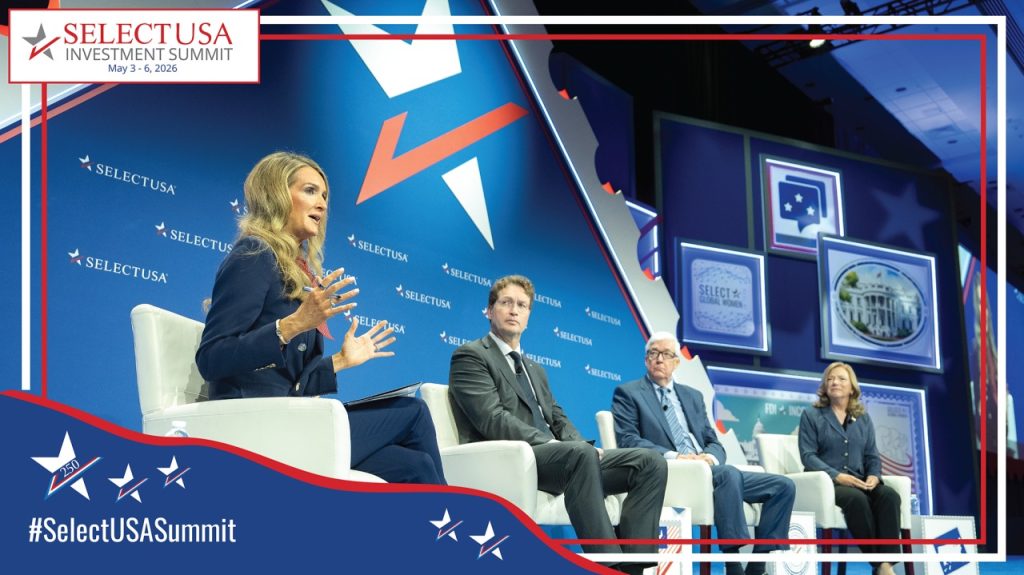
The SelectUSA Investment Summit 2026 delivered a powerful conclusion for governments, companies, and corporate leaders: in major international forums, simply being present is no longer enough. The true competitive advantage lies in the ability to build influence, project trust, and position a strong narrative within the global investment ecosystem.
Organized by the U.S. Department of Commerce, the event brought together thousands of investors, corporations, governments, and economic development organizations from more than one hundred countries. However, beyond the financial announcements and business opportunities, the Summit revealed a much deeper transformation: international investment has also become a competition for reputation, perception, and strategic leadership.
The New Global Competition: Reputation as an Economic Asset
One of the most visible aspects of SelectUSA 2026 was how countries and regions were no longer competing solely through incentives, infrastructure, or tax advantages. The delegations that generated the greatest impact were not necessarily the largest, but rather those capable of communicating a clear vision for the future.
Innovation, stability, sustainability, technological capabilities, and international coordination were among the most repeated attributes within the institutional narratives presented during the event.
The Summit confirmed that reputation is no longer a complementary element within investment attraction strategies. Today, it functions as an economic asset capable of directly influencing business expansion decisions and international partnerships.
In a global environment marked by geopolitical uncertainty, accelerated technological transformation, and supply chain reconfiguration, investors are seeking ecosystems that convey predictability, leadership, and adaptability.
Strategic Communication Is No Longer Support — It Builds Positioning
The 2026 edition also demonstrated how integrated marketing communications are playing an increasingly strategic role within these global scenarios.
Major international events are no longer merely corporate showcases or protocol-driven spaces. They have become platforms for institutional positioning, nation branding, and influence-building.
In this context, the organizations that stand out are not necessarily those generating the most visibility, but those capable of creating meaningful conversations, connecting industries, and projecting a coherent narrative to multiple audiences.
Presence without strategy quickly loses value. In contrast, brands that align reputation, leadership, purpose, and vision are able to transform participation into real opportunities for relationship-building and influence.
Corporate Leaders Also Represent Trust
Another particularly visible element during the Summit was the role of CEOs and corporate spokespersons within the global conversation.
Today, business leaders no longer represent only their companies. They also project stability, negotiation capabilities, organizational culture, and strategic vision.
Every public appearance, panel discussion, meeting, or interaction communicates attributes that directly impact the perception of investors, governments, and international partners.
In high-level forums such as SelectUSA, corporate leadership becomes a reputational tool. Executives function as ambassadors of trust within ecosystems where decisions increasingly depend on credibility and public perception.
Networking Is Evolving Toward Strategic Relationships
The event also highlighted a significant transformation in the dynamics of international networking.
The most valuable relationships are no longer born solely from spontaneous encounters or exchanges of business cards. They are built through strategic positioning, clear purpose, and consistent narratives.
The ability to connect with relevant stakeholders increasingly depends on how an organization communicates its vision, which conversations it leads, and what perception it generates within the global ecosystem.
In this scenario, integrated communications play a decisive role: aligning messaging, reputation management, public relations, public affairs, and branding to strengthen long-term relationships.
Economic Diplomacy, Technology, and Global Narrative
The Summit also reinforced the role of the United States as a platform for innovation, advanced manufacturing, and technological development.
Agendas related to artificial intelligence, semiconductors, quantum technologies, energy, healthcare, and sustainability confirmed the direction in which international economic competition is moving.
However, the true differentiator was how these capabilities were accompanied by a narrative focused on leadership, stability, and international projection.
Modern economic diplomacy no longer depends solely on trade agreements. It also depends on the ability to build global trust and position compelling narratives before investors and international markets.
Latin America Facing the Challenge of International Positioning
From the perspective of AXON marketing+communications, SelectUSA 2026 leaves particularly relevant lessons.
Latin America faces the challenge of strengthening not only its investment promotion strategies, but also its communication, reputation, and global positioning capabilities.
Competing internationally no longer depends solely on cost advantages or resource availability. It requires building strong narratives, conveying stability, and connecting innovation with a long-term vision.
Countries, cities, and organizations that communicate their value proposition more clearly will have greater opportunities to attract investment, talent, and strategic partnerships.
Influence Is Built Before, During, and After the Event
International events are no longer merely commercial spaces, and the SelectUSA Investment Summit 2026 confirmed this reality. These events have become platforms for influence, reputation, corporate leadership, and geopolitical positioning.
Those who attend simply to “be present” go unnoticed within an increasingly competitive global conversation.
On the other hand, organizations that arrive with an integrated communication strategy — aligning narrative, reputation, leadership, and relationship-building — are able to transform their participation into reputational capital and long-term opportunities.
For AXON marketing+communications, the key takeaway is clear: in today’s global economy, the ability to communicate vision, trust, and impact has become a strategic asset just as important as financial or technological capacity.
Because on the world’s biggest stages, it is no longer those who attend who win — it is those who build influence.