
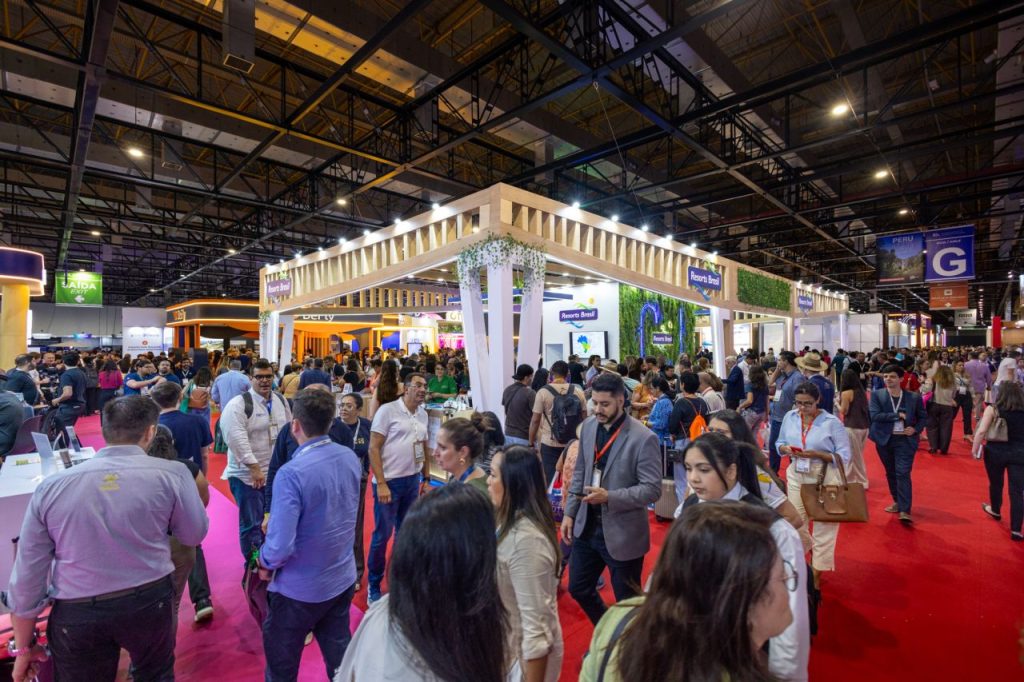
São Paulo, April 14–16, 2026 | Expo Center Norte | AXON Latam
WTM Latin America 2026 closed with numbers that are hard to ignore. More than 35,000 professionals. 936 exhibiting brands from 53 countries. Growth of nearly 11 percent year over year. A first-ever Ministers’ Summit bringing together representatives from eight countries. By any conventional measure, the event was a success.
But the most relevant signals from São Paulo were not in the attendance figures. They were in the conversations — in what the industry chose to prioritize, debate, and invest in. What emerged across three days at Expo Center Norte was a portrait of a sector that is growing faster than its own infrastructure, adopting technology faster than its governance frameworks, and facing a structural moment where the question is no longer whether Latin America will participate in global tourism, but on what terms.
The answers are not yet written. But the direction is clear enough to act on.
An industry that has outgrown its own narrative
For years, the dominant story of Latin American tourism has been one of untapped potential. The region has the geography, the culture, the biodiversity, and increasingly, the infrastructure investment to compete at a global level. That narrative is still accurate. But it is no longer sufficient.
What WTM 2026 made visible is that potential and performance are different variables, and the gap between them is widening in some markets while closing in others. The destinations and operators that are pulling ahead are not simply the ones with the most resources or the most attractive attributes. They are the ones that have figured out how to convert presence into positioning, and positioning into sustained economic value.
That shift has direct implications for how the industry communicates, how it competes, and how it measures success. Volume is no longer the right metric. Value capture is.
Artificial intelligence moves from conversation to infrastructure
Technology has been a fixture of WTM programming for several years. What was different in 2026 was the specificity. The conversation was no longer about whether AI would transform the industry — it was about which tools were already deployed, and what the results looked like.
Among the launches presented at the event, Lighthouse introduced The Hotels Network, described as the first direct booking app for hotels available within ChatGPT. The premise is operationally significant: hotels displaying real-time rates inside AI-powered search environments, eliminating intermediary commissions and recovering direct control over client communication. This is not a feature update. It is a structural repositioning of the hotel-to-traveler relationship.
In parallel, the IO V2 and IO Pro systems demonstrated how revenue management in hospitality is evolving from historical pattern analysis toward forward-looking intelligence — incorporating external data on air demand, local events, and market movement to inform pricing decisions in near-real time.
The platform Wikitravel.ai, presented by Grupo Schultz, addressed a different but equally critical problem: the fragmentation of destination data in public tourism management. By consolidating strategic information at the municipal level and generating actionable intelligence for tourism administrators, the platform points toward a future where public-sector decision-making in tourism operates with the same data density as the private sector.
What this means: The adoption curve in tourism technology has accelerated significantly. Organizations that treat AI as a future consideration rather than a present competitive variable are already operating with a structural disadvantage. More importantly, the value of technology adoption in this sector is not primarily in cost reduction — it is in the quality and granularity of insight that now shapes every level of the value chain.
Regenerative tourism: from aspiration to policy architecture
Sustainability has been a theme at WTM for years. What distinguished the 2026 edition was the institutional weight behind the conversation. The Ministers’ Summit — a first for the event — brought together tourism ministers from Uruguay, Mexico, Panama, Chile, Guatemala, Brazil, and Argentina to discuss shared frameworks around responsible and regenerative tourism.
The Sustainable Tourism Awards, now in their sixth edition, received 191 submissions from 16 countries. The winning initiatives spanned active biodiversity conservation, inclusive employment models, and community-led destination development. What they shared was a logic that goes beyond minimizing negative impact: they demonstrated how tourism can function as a regenerative mechanism — one that actively restores ecosystems, strengthens communities, and creates durable economic value in the territories it touches.
This framing — regenerative rather than simply sustainable — is not semantic. It carries different implications for how destinations structure their offerings, how they measure impact, and how they communicate value to international buyers and investors.
What this means: Sustainability is no longer a reputational layer that organizations add to their core positioning. It is increasingly a condition of access — to institutional partnerships, to premium market segments, and to the policy frameworks being built at ministerial level across the region. Brands and destinations that cannot articulate a credible regenerative narrative are being structurally excluded from conversations they cannot see happening.
Regional integration as a competitive strategy
One of the most substantive panels at WTM 2026 was titled ‘América para América’ — a deliberate signal about where the industry sees its next phase of growth. The argument, advanced by former Chilean Tourism Minister Veronica Pardo among others, was that Latin America has been under-investing in intra-regional tourism relative to the opportunity.
The region’s extraordinary natural and cultural diversity has historically been packaged for international visitors arriving from North America, Europe, and Asia. What the panel argued — with growing industry alignment — is that the most durable growth opportunity lies in Latin Americans traveling within Latin America, across borders and between ecosystems that the region has not yet learned to market to itself.
This argument has structural support. Embratur’s presentation at the event highlighted the PATI program — a coordinated national initiative involving the Ministries of Tourism and Ports and Airports — designed to attract international flights to Brazil and expand connectivity. The program projects nearly 8 million additional annual seats compared to 2022 levels, representing an 80 percent increase in connectivity capacity.
Connectivity is the enabling infrastructure of regional integration. Without it, the aspiration remains geographic. With it, the itinerary economics of intra-regional travel fundamentally change.
What this means: The competitive logic for destinations, operators, and brands in the region is shifting from market-by-market to corridor-based. Organizations that position themselves for multi-country regional narratives — rather than building isolated national propositions — will be better positioned to capture the next phase of demand as connectivity expands and intra-regional travel grows.
Indigenous and community tourism: a segment entering its commercial moment
For several editions of WTM, indigenous and community tourism has been present at the margins of the main programming. In 2026, it moved toward the center.
The panel dedicated to indigenous tourism brought together Frank Antoine, President of the World Indigenous Tourism Alliance, alongside operators from Mexico and Chile. The conversation was notable for its candor — and for the commercial seriousness with which it engaged a segment that has often been treated primarily through a social development lens.
‘Our culture is not for sale, but we see tourism as an opportunity to share and to educate,’ Antoine said. The representatives were unanimous on a defining principle: that the authenticity of indigenous tourism is inseparable from community sovereignty over the experience. Communities must be at the center of planning and decision-making, not at the periphery of someone else’s itinerary design.
The sustainability awards reinforced this signal, with multiple winners in biodiversity, social inclusion, and community-led categories — including a Nicaraguan initiative recognized for its inclusive employment model and a Costa Rican reserve receiving gold in the regenerative tourism category.
What this means: This segment is transitioning from niche to premium mainstream. The window for early positioning — before the segment becomes crowded and before its defining narratives are set — is open now, but it is not indefinitely open. For operators and destinations with genuine community partnerships and credible governance models, the moment to build visibility in international markets is this cycle.
The new traveler: personalization as the baseline expectation
Across panels, presentations, and bilateral conversations at WTM 2026, one behavioral shift was consistent: the traveler that the industry is now designing for is fundamentally different from the traveler of five years ago.
The combination of AI-powered planning tools, dramatically expanded content ecosystems — including Brazil’s Embratur-Netflix partnership as a case study — and post-pandemic recalibration of travel motivations has produced a traveler who expects experiences to be personally relevant, not generically well-reviewed. The distinction matters: a destination with exceptional aggregate ratings can still underperform if it cannot communicate specificity to the right audience.
This is the logic behind the growth of boutique hotel associations operating without standardization — preserving individual property identity while providing the operational and marketing infrastructure that independent operators cannot build alone. It is the same logic behind the emergence of reservation capabilities inside AI chat environments: the moment a traveler expresses intent, the pathway to booking should be frictionless and specific.
What this means: Mass positioning is becoming a disadvantage in tourism marketing. The organizations that capture disproportionate value in the next phase will be those that have built the data infrastructure, the content depth, and the channel architecture to operate at the level of segment specificity that the new traveler demands. One message, one audience, one channel is no longer a creative choice — it is a strategic liability.
The AXON Insights perspective
- WTM Latin America 2026 marks a structural inflection point for tourism across the region — not a peak, but a shift in the nature of competition.
- Growth is no longer evenly distributed. The gap is widening between destinations and operators that have built the conditions to capture value — through positioning, data infrastructure, stakeholder coordination, and narrative coherence — and those that remain present in the market without converting that presence into sustained performance.
- Artificial intelligence is no longer a future investment. It is a present operational variable affecting pricing, distribution, guest acquisition, and destination management. Organizations that treat it as a horizon are already behind organizations that treat it as infrastructure.
- Sustainability has moved from communications layer to strategic architecture. The ministerial-level conversations at WTM 2026 signal that regenerative credentials will increasingly function as conditions of access — to institutional partnerships, preferred itinerary placement, and premium segment demand.
- Regional integration is the most underdeveloped growth opportunity in Latin American tourism. As connectivity expands and intra-regional travel increases, the organizations with multi-country positioning and corridor-level narratives will have a structural advantage over those operating with national or destination-specific frames.
- Reputation is not a communications outcome — it is the mechanism through which all other competitive advantages become visible to the market. In a sector where every destination and brand is competing for attention across an expanding global choice set, the ability to communicate clearly, consistently, and credibly at the regional level is not a support function. It is a core competency.
- The risk for Latin America is not being absent from global tourism. The risk is being present without capturing real value. WTM 2026 showed the path forward. The question is which organizations have the architecture to take it.
AXON marketing+communications | axonlatam.com